
Thank you, Ginger
On trust and dogs doing their dog things

It’s the little things. That’s when grief sneaks up the most.
When I drop food scraps on the floor while cooking and realize a hungry dog won’t come running. When my joints ache because I haven’t taken our daily walk. When I come home to a painfully silent house and catch myself looking for her. When I’m out and about and remember that I don’t need to hurry home to let her outside.
In a season of freelance work that comes and goes, my regular commitments provide little daily structure. I’m feeling the void of the regular rhythm that caring for a senior pup provided: breakfast followed by a short morning walk, the afternoon longer walk, dinner precisely at 5pm, the 8pm Greenie. She was incredibly punctual.
I’m adrift without the routine she sometimes annoyingly held me to, and I’m also really missing her comfort. Her death has made me realize that through all the major losses of my adulthood—and there have been many—my default coping mechanism in the acute phase of early grief has been to cuddle with her and take long walks together. Our bodies, so attuned to one another, would co-regulate: our breath would sync and my anxiety would slowly dissipate.
My heart and body are really missing her right now.
The morning of Ginger’s death, I cuddled with her as long as I could. Spooning her while she slept, I soaked up her warmth and let the rhythmic sounds of her snoring soothe me one last time. At first, my mind raced, struggling to comprehend the idea of scheduling her passing. I second guessed my decision and wondered if she could sense what was coming just a few hours later, if she felt as afraid as I did. The anxiety and grief shortened my breath, making any sort of rest feel impossible.
But then, I gave myself into the moment for what it was: a beautiful end to a decade of love. I simply let myself be there, savoring her love for me and my love for her. Soon enough, I noticed that our breath flowed together. Each inhale and exhale in sync, my body began to relax, my frantic energy melting into a sorrowful mixture of gratitude, love, and pain.
I whispered my thanks to God for her life—the timeliness of it, the joy of it, the pure delight of it. I whispered thanks to God for all the little lessons her companionship taught me: what unconditional love looks like, how to find enjoyment in daily routines, how to truly rest, how to simply be what you’re meant to be, among so many others.
And then I felt God whisper back: “Will you let me love you the way that you love Ginger?”
I’ve been pondering these mysterious words in the week since.
So many people, when learning of Ginger’s declining health, said things like “you’ll know when the time is right,” or “she trusts you to make the best choice.” This last one really struck me. She trusts me? What an enormous responsibility.
When I first got picked by Ginger in the shelter back in 2015, I brought her home knowing absolutely nothing about her other than how sick she was. Based on scarring and injuries, the vet thought she might have been used as a bait dog in dog fighting. This suspicion felt all the more likely when I realized how dog-reactive she could be. If we encountered a dog while taking a walk, we’d have to immediately cross the street and hide behind a car or she would lash out rather aggressively. Given her musculature, she broke multiple harnesses in her violent outbursts and even once re-injured my previously dislocated shoulder. But with patient and consistent training, her behavior began to improve little by little.
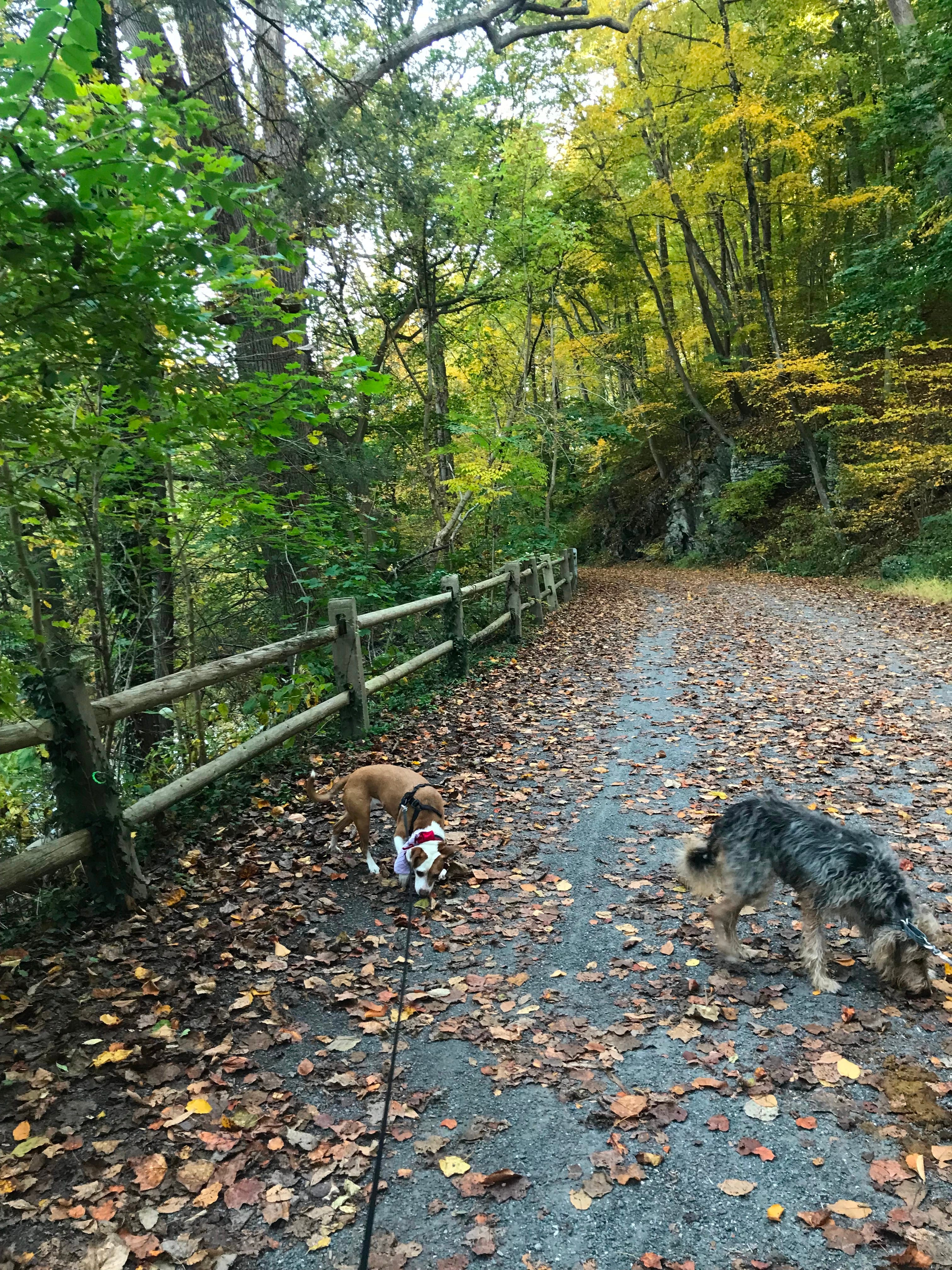
But one day, I took her on a hike. I chose a route I thought would be fairly empty, free of other animals. Unfortunately, at perhaps the narrowest point on the trail, we encountered another dog. Without an option to cross a street and hide behind a car, I scooped up her nearly 50-pound body and held her tight, turning away from the other dog. To my surprise, instead of raising her hackles, snarling, or trying to launch herself aggressively forward, she leaned in for a sniff and even wagged her tail.
I was stunned at first, but it made sense: when left on her own, she attacked not out of arbitrary aggression, but out of fear. She was trying to defend herself against a potential threat, against the unknown. But in my arms, the fear disappeared. In my arms, she felt safe enough to relax and even be curious about what scared her.
It was the first time I realized that she didn’t just love me; she trusted me. And that trust transformed her.
Over the years, with careful introductions that always began in my arms, she ended up having quite a few dog friends. She was able to learn to play tug, to chase, to sniff butts, dig holes, and do all the dog things that she otherwise wouldn’t have been able to do given her trauma history.
Trust goes so far.
Ginger trusted me because I made her feel safe. She knew I would provide for her, protect her, and only encourage her to interact with another dog when I knew that dog would be sensitive to her needs.
So my heart is now wondering if this is the final lesson Ginger is teaching me, even in death. God’s question to me—will you let me love you the way that you love Ginger? —is perhaps asking me about trust.
Will I allow myself to be held in God’s loving arms? Will I allow myself to enjoy God’s protection enough to relax and maybe even grow curious about that which feels threatening? What new possibilities for joy and connection might this kind of trust open up?
With all my heart and love, thank you, Ginger.
💔 thinking of you very much.